Inicio – Blog–IP67 Waterproof D-Sub connector Solutions
Choosing the Right Waterproof D-Sub Connector for Outdoor Equipment
Introducción
If you’re specifying or troubleshooting connectors for equipment that lives outside — agricultural machinery, telecom cabinets, marine electronics, EV charging stations, outdoor lighting controllers, or rooftop HVAC units — you’ve probably already learned the hard way that a connector that works fine on a lab bench can fail within a single season outdoors. Moisture, dust, vibration, salt fog, and temperature cycling are unforgiving, and the connector is very often the weakest link in an otherwise solid design.
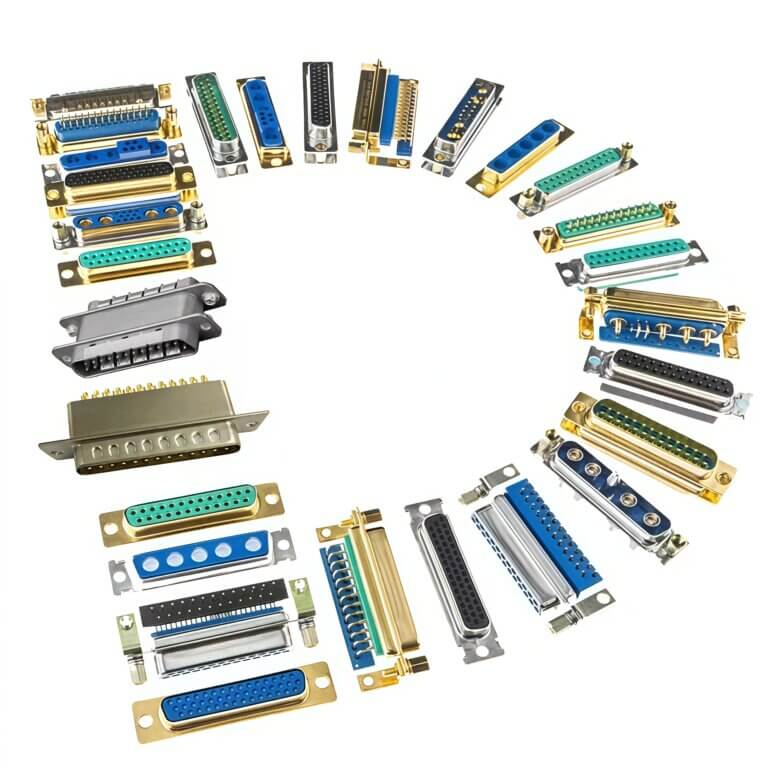
D-sub (D-subminiature) connectors are among the most widely used multi-pin connectors in industrial control and instrumentation, but the standard version was never designed for outdoor exposure. This guide walks through exactly why standard D-sub connectors fail outdoors, what makes a waterproof version different, and gives you a concrete, step-by-step method to select the right part the first time — along with comparison tables, failure-mode data, installation guidance, and a maintenance checklist you can hand to a field technician.
Why Standard D-Sub Connectors Fail Outdoors
A standard commercial D-sub connector — the kind found in server rooms and indoor control panels — is an open-frame design. There is no gasket at the mating interface and no seal where the cable exits the shell. Outdoors, this creates several predictable failure paths:
- Capillary water ingress: moisture is drawn along the pins and around the insulator by capillary action, even without direct rain contact — condensation alone is often enough.
- Contact corrosion: once moisture reaches the contact area, tin or bare-metal plated pins oxidize, increasing contact resistance and causing intermittent signal dropouts long before a visible failure occurs.
- Dust and particulate bridging: conductive dust or salt residue can bridge adjacent pins, especially in high-density layouts, causing shorts or crosstalk.
- Vibration-induced disconnection: standard friction-fit or basic jackscrew retention is often insufficient for equipment mounted on vehicles, compressors, or vibrating machinery, allowing the connector to gradually back out.
- UV and thermal degradation: standard plastic insulators and cable jackets can become brittle under prolonged UV exposure and thermal cycling, eventually cracking and opening a path for moisture.
What Makes a Waterproof D-Sub Connector Different?
A true waterproof D-sub connector is engineered specifically to close the gaps described above. The key differences are:
- Die-cast, one-piece metal shell (typically zinc alloy or aluminum) instead of a stamped and seamed shell — eliminating seam-based leak paths.
- A compressed gasket or O-ring at the mating face between the male and female shells, tested to a specific IEC 60529 IP rating.
- A sealed cable exit — achieved through epoxy potting, an overmolded boot, or a compression cable gland — so water cannot wick in along the conductor strands.
- Corrosion-resistant plating on both the shell (chromate, nickel, or powder-coat finishes) and the contacts (typically gold-flash over nickel) to resist long-term oxidation.
- Positive mechanical locking via jackscrews, threaded locking rings, or spring latches rated to withstand sustained vibration.
These features together allow a connector to be tested and rated to IP67, IP68, or even IP69K, versus a standard connector which carries no ingress protection rating at all. Our zinc alloy waterproof D-sub connector series is built around exactly this construction.
How to Choose the Right Waterproof D-Sub Connector
Selecting the right connector is a repeatable process. Work through these seven steps in order — each one narrows the field before you move to the next.
Step 1: Identify the Environment
Start by characterizing the actual operating environment, not just “outdoor.” Consider: Is the equipment exposed to direct rain, or sheltered under a canopy? Will it see salt spray (coastal or marine)? Is it wash-down cleaned with pressurized water? Will it ever be submerged, even briefly? What’s the temperature range — desert heat, arctic cold, or both? This single step determines almost everything downstream, particularly the IP rating and shell material.
Step 2: Choose the Correct IP Rating
Match the environment to an ingress protection rating per IEC 60529. As a starting point: IP65 for sheltered outdoor cabinets with light rain exposure only; IP67 for direct weather exposure, general outdoor equipment, and vehicles; IP68 for equipment that is regularly submerged or buried; IP69K for equipment cleaned with high-pressure, high-temperature jets. See the detailed IP rating comparison table below.
Step 3: Select the Shell Material
Zinc alloy (zamak) is the most common choice for waterproof D-sub shells, offering excellent die-casting precision, a smooth sealing surface, and good corrosion resistance when plated. Aluminum is lighter and often preferred for weight-sensitive designs. Stainless steel is used in the most aggressive corrosive or high-strength applications. See the full material comparison table.
Step 4: Determine Pin Count
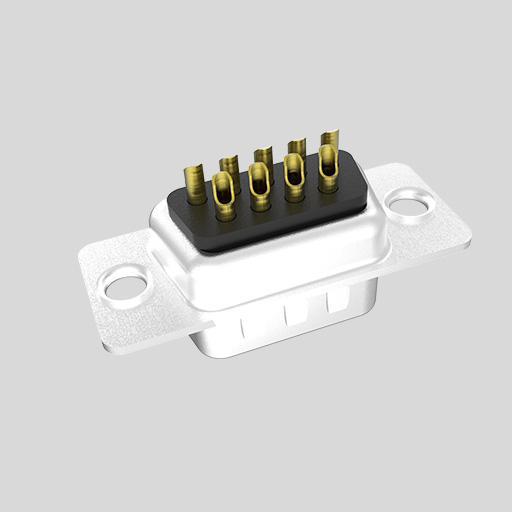
Count the actual number of signal, power, and ground lines your design requires, then add margin for future revisions. Common D-sub pin counts are 9, 15, 25, 37, and 50. For outdoor control and instrumentation applications requiring a moderate number of mixed signals, a D-sub 25-pin female connector is one of the most frequently specified sizes, offering a practical balance between signal density and physical footprint.
Step 5: Select the Mounting Style
Decide whether you need a panel-mount receptacle (fixed to an equipment enclosure) or a cable-to-cable in-line connector. Panel-mount versions typically require a mounting flange and gasket against the enclosure wall itself — the enclosure cutout and panel seal matter just as much as the connector’s own rating.
Step 6: Choose the Locking Mechanism
For vibration-prone equipment (vehicles, compressors, rooftop units), specify jackscrews or a positive latch rather than relying on friction fit alone. Threaded locking rings offer the highest resistance to vibration back-out but take longer to mate and unmate in the field — weigh this against your maintenance access needs.
Step 7: Verify Electrical Ratings
Confirm the voltage and current rating per contact against your actual circuit demands, including inrush current and any surge conditions. Undersized contacts are a common but avoidable cause of overheating and premature contact degradation, especially in connectors also carrying switched loads.
Waterproof D-Sub Connector Selection Matrix
Use this matrix as a quick-reference starting point once you’ve characterized your environment in Step 1.
| Application Environment | Recommended IP Rating | Recommended Shell Material | Recommended Locking |
|---|---|---|---|
| Sheltered outdoor cabinet (roof/canopy covered) | IP65 | Zinc alloy, standard plating | Jackscrew |
| Direct weather exposure (rain, snow, general outdoor) | IP67 | Zinc alloy, nickel/gold plating | Jackscrew or latch |
| Vehicle / mobile machinery (vibration + weather) | IP67 | Zinc alloy or aluminum | Latch or threaded locking ring |
| Coastal / marine deck equipment | IP68 | Marine-grade zinc alloy or anodized aluminum | Threaded locking ring |
| Buried or regularly submerged equipment | IP68 | Stainless steel or marine-grade zinc alloy | Threaded locking ring, potted cable exit |
| Wash-down / food-processing / agricultural equipment | IP69K | Stainless steel | Threaded locking ring |
Material Comparison Table
| Material | Corrosion Resistance | Peso | Relative Cost | Lo mejor para |
|---|---|---|---|---|
| Zinc alloy (zamak), plated | Good to very good (plating-dependent) | Moderate | Low-moderate | General outdoor and industrial equipment; best balance of cost and performance |
| Aluminum, anodized | Bien | Light | Moderate | Weight-sensitive equipment, portable devices, aerospace-adjacent applications |
| Stainless steel | Excellent | Heavy | Alta | Marine, chemical, or wash-down environments with aggressive corrosion exposure |
| Standard stamped steel (non-sealed) | Poor outdoors | Light | Lowest | Indoor use only — not recommended outdoors |
IP Rating Comparison Table
| Clasificación IP | Dust Protection | Water Protection | Typical Outdoor Use Case |
|---|---|---|---|
| IP65 | Dust-tight | Protected against low-pressure water jets from any direction | Sheltered outdoor cabinets, indoor wash-down areas |
| IP67 | Dust-tight | Protected against temporary immersion up to 1m for 30 minutes | General outdoor equipment, vehicles, rooftop units |
| IP68 | Dust-tight | Protected against continuous submersion at manufacturer-specified depth/duration | Marine equipment, buried enclosures, subsea sensors |
| IP69K | Dust-tight | Protected against high-pressure, high-temperature wash-down jets at close range | Agricultural machinery, food-processing, heavy wash-down equipment |
Ratings follow the IEC 60529 IP code system. Always request the manufacturer’s actual test report rather than assuming a rating based on the shell design alone — the rating applies to the specific tested assembly, including the correct cable and backshell combination.
Common Outdoor Failure Modes and How to Prevent Them
| Failure Mode | Root Cause | Prevention |
|---|---|---|
| Intermittent signal loss | Corroded contacts from moisture ingress | Use IP67+ rated connector with gasket sealing verified during installation |
| Connector backs out under vibration | Friction-fit or single jackscrew insufficient for vibration levels | Specify latching or threaded locking mechanism; torque jackscrews to spec |
| Water tracks in along the cable | Unsealed or poorly potted cable exit | Use potted backshell, overmolded boot, or properly sized cable gland |
| Cracked shell or insulator | UV degradation of low-grade plastic components over years outdoors | Specify UV-stabilized insulator material and metal (not plastic) shells |
| Gasket failure after a few years | Low-grade gasket material hardening or compression-setting | Use quality silicone or fluorosilicone gaskets rated for the expected temperature range |
| Contact overheating | Undersized contacts for actual current draw | Verify current rating per contact against real circuit load, including surge |
Typical Outdoor Application Examples
- Agricultural machinery: tractor and implement control wiring exposed to mud, rain, and constant vibration — typically IP67, zinc alloy, latch or jackscrew locking.
- Telecom and utility outdoor cabinets: roadside cabinets exposed to rain and temperature swings — typically IP65–IP67, zinc alloy with gasketed panel mount.
- Marine electronics and deck equipment: navigation, communication, and control wiring exposed to salt fog and spray — typically IP68, marine-grade zinc alloy or anodized aluminum, gold-flash contacts.
- EV charging stations: outdoor charger control and communication interfaces exposed to weather and repeated public use — typically IP67, high-cycle-life locking hardware.
- Rooftop HVAC and solar installations: control and monitoring wiring exposed to UV, rain, and thermal cycling — typically IP67, UV-stabilized insulator materials.
- Wash-down and agricultural processing equipment: control panels cleaned with high-pressure hot water — typically IP69K, stainless steel shell.
Installation Best Practices
- Inspect the gasket before every mating cycle — a pinched, torn, or missing gasket eliminates the entire rated seal regardless of connector quality.
- Torque jackscrews and locking hardware to the manufacturer’s specification — under-tightening leaves the gasket uncompressed; over-tightening can distort the shell.
- Support the cable near the connector with a strain-relief clamp so that flexing and vibration loads are not transferred directly to the cable exit seal.
- Orient cable exits downward or sideways where possible, rather than straight up, to prevent standing water from pooling against the seal.
- Apply dielectric grease sparingly on contacts in the harshest marine or coastal environments, if recommended by the connector manufacturer, to add an additional moisture barrier.
- Never assume field-cut or after-market cable glands maintain the original IP rating — use the connector manufacturer’s specified cable and backshell combination, since IP ratings are tested as a complete assembly.
Maintenance Checklist
- ☐ Visually inspect the connector shell for cracks, corrosion, or gasket degradation every 6–12 months
- ☐ Confirm locking hardware (jackscrews, latches, locking rings) is fully engaged and torqued correctly
- ☐ Check for signs of water staining or residue at the cable exit and mating interface
- ☐ Measure contact resistance periodically on critical circuits if intermittent faults have occurred
- ☐ Clean salt or dust buildup from the exterior shell with a non-abrasive cloth; avoid solvents that can degrade gasket material
- ☐ Replace gaskets proactively if the connector is being unmated and remated for scheduled maintenance
- ☐ Keep a record of connector part numbers and IP ratings on file so replacements match the original specification exactly
Preguntas frecuentes
Are D-Sub connectors waterproof?
Not by default. Standard D-sub connectors are open-frame designs with no gasket or sealed cable exit, so water and dust can enter freely. Waterproof D-sub connectors are a distinct product category, using gasketed shells, potted or overmolded cable exits, and die-cast metal housings to achieve IP67 or higher ingress protection.
What IP rating is best for outdoor equipment?
IP67 is the practical baseline for most outdoor equipment, protecting against dust ingress and temporary immersion in up to 1 meter of water. Equipment exposed to prolonged rain, wash-down, or occasional submersion should use IP68. IP69K is recommended for equipment cleaned with high-pressure, high-temperature jets, such as agricultural or food-processing machinery.
Zinc alloy vs aluminum: which is better?
Zinc alloy (zamak) offers excellent die-casting precision, a smooth sealing surface for gaskets, good corrosion resistance when plated, and lower cost at scale, making it the most common choice for waterproof D-sub shells — see our zinc alloy waterproof D-sub connector line. Aluminum is lighter with better strength-to-weight and thermal conductivity, making it preferable for weight-sensitive applications, but it typically costs more and needs additional surface treatment for equivalent corrosion resistance.
Can waterproof D-Sub connectors be submerged?
It depends on the specific IP rating. IP67-rated connectors are tested for temporary immersion up to 1 meter for 30 minutes, covering rain, splashing, and brief flooding, but not continuous submersion. IP68-rated connectors are tested for continuous submersion at a manufacturer-specified depth and duration, making them correct for equipment that is regularly or permanently underwater.
How do I identify the correct waterproof D-Sub connector?
Confirm pin count and shell size, gender (male or female), the IP rating your environment requires, shell material and plating, mounting style (panel mount or cable-to-cable), and locking mechanism. Cross-check these against the manufacturer’s datasheet and printed part number before ordering — for a common industrial example, see our D-sub 25-pin female connector.
What connector should I use for marine applications?
Marine applications should use a waterproof D-sub connector with an IP68 rating, a corrosion-resistant shell (marine-grade zinc alloy with nickel or gold plating, or anodized aluminum), and gold-flash plated contacts to resist salt-fog corrosion. A fully potted or overmolded cable exit is recommended to prevent water wicking along the conductor strands.
How long will a waterproof D-Sub connector last outdoors?
A properly specified and installed waterproof D-sub connector typically lasts 10 to 15+ years in outdoor service, limited mainly by gasket aging, UV exposure, and mechanical wear from mating cycles rather than sudden failure. Lifespan is significantly reduced by incorrect IP rating selection or poor installation, such as an uncompressed gasket or an unsealed cable entry.
Final Recommendation
There is no single “best” waterproof D-sub connector — only the correct connector for your specific environment, pin count, and mechanical requirements. Start by honestly characterizing your operating environment, then work through the IP rating, shell material, pin count, mounting, locking, and electrical rating steps in order. When in doubt, it is almost always cheaper to over-specify the IP rating and shell material up front than to replace failed connectors and troubleshoot intermittent field faults later.
For outdoor and industrial applications, our IP67 D-sub connector series y zinc alloy waterproof D-sub connectors are engineered to the specifications outlined in this guide. Browse the full range, or contact our technical team with your application details for a specific part recommendation.